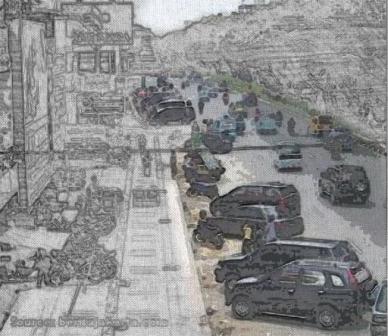
trafic jam

Tuesday, February 14, 2012

Don't Forget to Remember Pedestrians

Jakarta Metropolitan is not for pedestrians. Certainly, Jakarta has not been designed for it. The city seems to be prioritized for the cars’ mobility. No comfortable sidewalks are available nor zebra-crosses are enough for people to stroll around enjoying the metropolitan life. 

The condition of pedestrian access is poor not only in the periphery of the city but also in business, shopping, tourist and office areas where many people used to circulate carrying out their routine activities. 

The pedestrians would be pleased if the sidewalks are free from obstacles such as sidewalk traders and parking vehicles. Ideally, the width of the sidewalks at the protocol road is 5 meters and non-protocol roads 3 meters, but they would be more than happy if they can stride on good sidewalks even though they are narrower. 


The city government seems to be indifferent by the misuse of the sidewalks. The city government may claim that they have modern management but fail to recognize the basic problem of the city. Permissiveness for people not to observe discipline, cleanliness, and tidiness under the reason of poverty is the source of the problem not only in Jakarta but nationwide. 

On the strategic spots, many sidewalks are occupied by traders, some of whom have semi-permanent stalls on them. Many parking-men are careless about the interest of the pedestrians and just let the vehicles park on the sidewalks hindering the pedestrians to easily pass along the sidewalks. 

In order to beautify and make the city become greener, the city government allows some flower cultivators to display their ornamental plants on the sidewalks which in many cases take the whole sidewalks area leaving out little or no space for pedestrians. 

Recently city officials start to recognize that most of the sidewalks in Jakarta are in poor condition. Some are heavily damaged, some are too small, and others are almost at the same height as the road level making the motorcycle drivers who are trapped in a traffic jam can easily run over the sidewalks endangering pedestrians. 

Realizing the previous negligence, the city government today is trying to improve at least 13 sidewalks and make them exemplary models mainly in Central Jakarta. In addition, regular patrol to drive out the sidewalk traders and demolish their illegal stalls, if any, or other obstacles for pedestrians will be carried out regularly. 

Jakarta City Government should not be hesitated to make a comparative study to Surabaya. The Surabaya mayor has renewed water channel and at the same time improved the sidewalks above it. All activities on the sidewalks which have nothing to do with pedestrians are reduced and prohibited. The sidewalk traders are given special places for them to sell their merchandise and staple diet. 

Some of the sidewalks were paved with marble stone blocks to beautify the sidewalks.  Several statues and art ornaments are erected in some sidewalks making people feel comfortable to stroll. In the meantime, city police and officials regularly patrol around the city to make sure that either traders, parking-men or homeless families make use of the sidewalks for their own needs. 

One of the advantages that Surabaya gains in improving the management of sidewalks are because the current city mayor was formerly the chairman of City Park and therefore she knows well all about the problems related to the sidewalks. 

But above all, in order to manage the city properly, the city government should change their mindset that the discipline should be held and strictly imposed on their residents. Orders, cleanliness and tidiness are everybody’s duty to keep for the benefit of all people anywhere and any time.

Wednesday, December 7, 2011

Will North Jakarta Subside below Sea Level?

It is alarming that the level of seawater inundating Jakarta coastal area is getting higher and higher. Today we can notice that at certain spots in Jakarta coastal area the sea water level invading the land could reach up to 2 meters during high tide. Some people think that Jakarta coastal area is in the process of submerging below the sea level. 

Does such a phenomenon really happen in Jakarta? Some surveys conducted in coastal areas indicate that the subsidence of the areas may reach 10 centimeters annually. However, we have to be extremely prudent about such a diagnosis as it may lead us to the wrong solution.

It is true that for some dense populated and industrial areas which are relatively far from the coast,  the high withdrawal rate of the groundwater through the wells drilled in those areas may cause slight land subsidence.

However, this groundwater withdrawal unlikely affects the subsidence in the coastal areas. The evidence of the seawater intrusion up to Central Jakarta proves that such water withdrawal has been compensated by the seawater intrusion to the groundwater formation in those areas. 

There are, indeed, certain spots in the coastal areas which are subsiding, such as on the site of Muara Karang power plant, but all of those subsided areas are ex-coastal land reclamation and cannot be generalized to happen elsewhere. 

Some experts pointed out to the rise of sea water level which is about one centimeter annually. Once again, we have also to be cautious to such claim as the sea water rise should be globally occurring and should be verified whether it occurs elsewhere.

One thing for sure that the sedimentation which raises the riverbed in the estuary of 13 rivers in the Jakarta Bay is the main cause of the sea flood. In the high tide, these shallow estuaries resulting in the mixture of water from the rivers and the sea spill over the surrounding low areas. The original deep estuaries function like "safety valves" which allow the high tide seawater flow deep toward the upstream of the rivers and not spill over the drylands. 


Based on the premise that sea floods coming frontally through the coastline,  the City government is currently planning to construct a high polder along the coastal area preventing for the entry of seawater, locally called rob. The polders will be constructed in two sections of the coastal areas which are vulnerable to sea floods, namely Penjaringan to Kapuk Subdistrict in the west and Marunda to Kelapa Gading in the east.

The initial step is to improve the broken parts of the existing polder and water gates, and by doing so the city government promises that in 2012, North Jakarta will be free from sea flood. The next step is to construct a high polder along Jakarta Bay complete with water gates of 200 meters long to allow ocean liners to make their entry into and go out of Tanjung Priok Port.

Such an ambitious and "luxury" plan definitely will require a huge amount of money. Before the city government goes further with the plan, it is highly advisable to re-scrutinize the diagnosis of the cause of the sea flood in order to get a more proper solution.

We have to consider what some experts said that areas bounded by such high polder will easily become shallow caused by the huge amount of mud and solid wasted discharged by all of those rivers into Jakarta Bay. 

It is highly recommended that the city government spends instead the loan or allocated budget, which is originally destined for the polder construction,  for the periodic dredging of those estuaries and river rehabilitation.  Some of the funds could be also used for relocation of the illegal huts along the river banks and for Jakarta clean rivers campaign. Such spending is definitely much lower than that required for the polder construction.

Monday, November 7, 2011

Reorganized Parking Areas along the City Roads

Jakarta as a metropolitan city surprisingly doesn’t have a comprehensive regulation on the parking areas along the city side roads, even in the busiest areas in the heart of the city. The clear example of this is the misuse of side roads of Hayam Wuruk and Gajah Mada which connect the administrative area with the downtown.

The parking areas along the side roads of these lanes have long been known as the source of traffic jam almost all day long. The city government seems indifferent toward the situation and blames instead that the number of cars crossing Jakarta is too many.

Realizing that the situation becomes worse and worse the city government issued the regulation forbidding anybody to park the vehicle along the side roads of those two lanes. As the alternative, the drivers who want to stop-by along those two lanes are required to park their vehicles at certain appointed spots especially the buildings or shopping centers having parking lots. Those areas are able to accommodate cars which are enough to replace the number of cars which were used to park along the side roads of those two lanes.

The drivers who were reluctant to follow this regulation simply parked their vehicles on the sidewalks hampering the pedestrians’ ways, permitted at the discretion of the parking-men. Obviously, this outrageous act paying no attention to the convenience of pedestrians definitely could not be tolerated for whatever reasons.

Following the stipulation of the policy, hundreds of registered parking-men along the two roads held a demo protesting for the policy. As they lost the jobs, the city government has removed them to other areas around Jakarta or channeled to special buildings with parking lots.

The government seemed determined to follow up with the policy and ignore the protests of the businessmen and traders who own the offices or shops along the two roads. The traders argued that buyers would be getting less as they should park their vehicles far away from the shops.

As the city government wants to restore order, a plan is set up to maintain the function of the sidewalk by making it a little bit higher and make the areas more greenery by planting more trees and putting big pots containing flowers. At certain spots, iron pipes are already stuck deep into the ground to prevent any motorcycles and cars to pass through the sidewalks.

Today city officials are in the process of setting up the Detailed Engineering Design, and the project will be auctioned in the early of 2012. The city government should make sure that the public space for a pedestrian will not be taken over by sidewalk traders, which is the acute problem as occurs in anywhere else within the city.    

We hope that the project applied for Jalan Hayam Wuruk and Gajah Mada would be extended to other main roads throughout the city.

Monday, September 5, 2011

Jakarta, Once a Year Deserted City

When the best time for visitors should come to Jakarta to enjoy traffic-jam free? They may visit Jakarta around the celebration of Eid-al-Fitr, the Moslem most venerated day when almost 7 out of 12 million of its residents make an exodus to their hometown or village.

Indonesia may be a unique country which has a tradition for people to ask for pardon to each other on the celebration day, especially from the younger to the elders. To do that, as more than half of Jakarta residents originated from the countryside, they have to travel back to their native village as most of their parents and relatives stay there.


This year Eid-al-Fitr celebration fell on August 31 which arose controversy on its late stipulated date by the government. Most people had already prepared to celebrate the venerated day on August 30 as concordance with the public holiday stated in the calendar and were very surprised with such decision.

During the period of two days before and after the celebration, Jakarta resembled a deserted city. People who stayed in the city during this period might enjoy driving around downtown easily. The roads were almost free from any public and private transport as those who went to the countryside brought with them their own car or motorcycle.

However, contrary to the deserted roads, the amusement centers like Ancol Coastal and Indonesian Miniature Parks as well as Ragunan Zoo were flooded with citizens who stayed in the city and visitors coming from outside the city. During the last few days, the zoo already registered around 750,000 visitors.


In a certain degree, exodus caused problems for many families who stayed in the city, especially those who had hired the housemaids to do household chores. The housewives had to take over all duties of the housemaids and often went outside with their whole family for having lunch and dinner. And because of this reason, people were crowded in the hyper-marts and malls. 

The exodus also made most of the houses empty and only some big houses were guarded by the security. The district heads always reminded the citizens to report their departure so they could keep eyes on their houses. Some districts even asked the staying residents to help guard the area, especially on the weekend.  

For the city government, it was a good time for them to topple down empty illegal huts and stalls temporarily left by the owner. They were also used to screen the poor newcomers who came together with their residential relatives seeking the opportunity of getting the job. However, the past experience indicates that such governmental prevention has been unsuccessful and ineffective.

We wish you a happy Eid-al-Fitr!

Thursday, July 21, 2011

Can the Road Crossers be Disciplined?

Everybody knows that traffic jams in Jakarta are acute. The standard explanations for that are too many cars and too many motorcycles as compared to the roads available. The situation is worsened by the non-disciplinary drivers, merchandizes put at the side of the road by unconcerned traders, the cars parked at the side of busy roads, and last but not least people cross the road at will.

Based on the reason for the frequencies of accidents of the road crossers and the traffic slow down caused by their crossing, the city government issued the regional law No. 22, 2009 to forbid and fine the person crossing the road at wrong sites. The law was dormant for some reasons for more than 2 years until the police revived it recently.

Under the law, the police are authorized to fine the road crossers Rp 250,000 (US$ 30) for those who don’t want to cross at zebra-cross, traffic light or crossing bridge fly-over the road. As try-out, the police held 2 weeks “Obedient Operation” this current month (July). At this stage, the police would not fine the violators but guide them to cross at the appointed spots.

After this try-out period, the police will impose a fine to the non-obedient road crossers or confiscate their ID cards to be proceeded to court session for recovering their ID after being fined. 

As it is anticipated, many people complain about the regulation for the reason that there are an insufficient number of the crossing bridges and definitely the number of zebra-crosses. For the latter, the government can easily increase the number of zebra-crosses by simply painting the roads in many spots required. In addition, the fine is considered as unreasonably high as most of the road crossers are low-income persons.   

So we urge the city government to paint Jakarta roads as many zebra-crosses as required and let's hope the citizens will obey the rule.