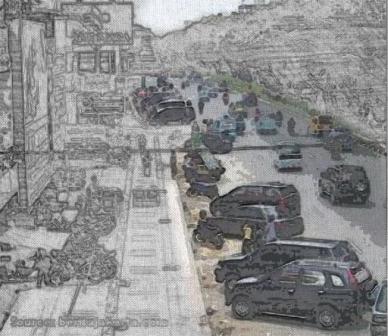
trafic jam

Showing posts with label traffic jam. Show all posts

Wednesday, January 20, 2016

Permata Hijau Flyover Avoids One Level Crossing


Jakarta is famous for its traffic jams. People are accustomed to cars and motorcycles packing on Jakarta streets. The number of cars and motorcycles are increasing significantly but very little new roads are built. To cope with this grave situation, Jakarta City Government built flyovers in several places especially above the roads crossing the peripheral railway track to curb the possible accidents colliding with the train. 

One of them is Permata Hijau flyover built crossing the railway Tanah Abang-Rangkasbitung completed in the first week of January 2016. Its length measured 533 meters and 12-meter height with a construction cost of Rp131 billion. 

Prior to the construction of the flyover, the road connecting Permata Hijau and Senayan is always packed with cars and motorcycles in the morning and afternoon especially at the spot where the road crosses over the railway tracks causing people to be late to go to offices or be back home in the afternoon.


The contractor was able to complete such a huge task successfully especially when they had to set the construction during the rainy season. Believe it or not, although we live in the modern era, a rumor circulated that while constructing the flyover the contractor hired 12 metaphysicists from Kalimantan, Central Java, and Banten to prevent the rain from falling down at the constructional area, thus, preserve the quality of wet cement from degrading. 

Though it is contrary to the logic, some people still use the service of metaphysicists to prevent rain in a wedding or cultural ceremony and performance but it looks funny when applied for civil construction work such Permata Hijau Flyover. 

Notwithstanding just few hundred meters from the flyover, there is a small pathway crossing the railway that some people still drive their cars and motorcycles across causing the danger of collision with the train remains. There are some free-lance boys (popularly called Pak Ogah) who guard the railway-crossing, but they work occasionally.


It seems that the purpose of Permata Hijau flyover construction which costs hundreds of billions of rupiah is in vain. The public discipline should be strongly held. The attitude of the government towards the people’s indiscipline is too weak especially to those considered as marginal such those who occupy the railway track or river banks.

We are waiting for firm action from the local authority. We can no longer tolerate people who don’t mind with the government effort to manage the traffic spending billon of rupiah. On behalf of orderliness, people should be ready to just take a little tour using the new imposing flyover built to make life better.

Thursday, September 19, 2013

Unpopular Jokowi’s Letter on Cheap Car to Vice President


Jokowi, the popular Jakarta Governor sent a letter to Vice President calling for the postponement for the sales of the low-cost green car (LCGC) in Jakarta. E.E. Mangindaan, the Minister of Transportation, wanted that the LCGC program should be carried out in line with the road infrastructure availability in the country. “The number of cheap cars should not be excessive because the infrastructure is not yet sufficient”, said he.

One may consider such a letter and statement as controversial. Most of the reasons that the opponents of the LCGC program have put forward are related to traffic problems. They show their worry that the traffic in the big cities will be stagnant as the infrastructures that are available would not be able to afford the additional LCGC.

But Jakarta does not reflect the image of Indonesia. In many small cities in the country, one may count with his fingers the vehicles that run on the road. After twilight, the roads in those cities are almost deserted. Obviously, the LCGCs are suitable for such cities. The LCGC is classified as the one which consumes one liter for 28 kilometer-distance, has 60 percent local content and the selling price below Rp 75 million  (US $6,800). Just a couple days after launching, almost 18,000 cheap cars have been sold out where most the buyers are those who live in Jakarta and nearby cities.


Low and middle-class people are eager to buy such cars as they cannot afford to buy a normal car which price beyond their purchasing power and buy motorcycles instead. Now having such a low price car available, some of them may convert from riding motorcycles to cheap cars. The haves may also buy the car as a second [or higher] vehicle especially for their kids.

The number of cars in Indonesia compared to its population is among the lowest in the world around one car for 40 people, compared that of the developed countries which ratio is 1:3. The availability of the LCGC will certainly increase the car population in Indonesia. Huge investment up to US$ 3.5 billion is required and it might absorb thousands of workers to fabricate the cars.

Definitely the LCGC mass productions will give a positive impact on the country economy as they improve the quality of the private transportation mode in term of fuel saving, transportation efficiency as compared to bigger and expensive cars, the condition of transportation mode especially for those using motorcycles and, last but not least, the environment.


However, a big controversy has arisen as the government launches the beginning of the mass production of LCGC. Isn’t that the people car (“mobil rakyat”) that the country is longing for? The car which is not exclusively for the haves but also for middle and lower class? Of course, to become a national people car, it is hoped that at the latest stage the local content would be close to 100 percent.

How come that we should against the relatively poor people for having a little comfort by possessing LCGC replacing their motorcycles in favor of the relatively rich people enjoying their “luxury” cars? Shouldn't we have the opposite standpoint by encouraging people to have LCGC as it gives so many benefits for the low income people?

Mr. Governor, we understood of your apprehension on the Jakarta traffic jams as they are already aggravated. But don’t you consider to impose the luxury car (more than 3000 ccs) usage limitation, by for example allowing them to circulate only beyond the office time instead of limiting the LCGC? Or more radically proposing to limit the production of the 3000 cc-cars or higher rather than that of LCGC?


The postponement of the cheap car mass productions will be a blunder as it will cause Indonesia to suffer a big loss, as by 2015 any ASEAN countries under AFTA can easily export their cheap cars into their neighboring countries. They have kept eyes to take any opportunities to inundate their cheap cars here and certainly will establish their sole agents in our country for selling their home-made cheap car. 

Monday, November 7, 2011

Reorganized Parking Areas along the City Roads

Jakarta as a metropolitan city surprisingly doesn’t have a comprehensive regulation on the parking areas along the city side roads, even in the busiest areas in the heart of the city. The clear example of this is the misuse of side roads of Hayam Wuruk and Gajah Mada which connect the administrative area with the downtown.

The parking areas along the side roads of these lanes have long been known as the source of traffic jam almost all day long. The city government seems indifferent toward the situation and blames instead that the number of cars crossing Jakarta is too many.

Realizing that the situation becomes worse and worse the city government issued the regulation forbidding anybody to park the vehicle along the side roads of those two lanes. As the alternative, the drivers who want to stop-by along those two lanes are required to park their vehicles at certain appointed spots especially the buildings or shopping centers having parking lots. Those areas are able to accommodate cars which are enough to replace the number of cars which were used to park along the side roads of those two lanes.

The drivers who were reluctant to follow this regulation simply parked their vehicles on the sidewalks hampering the pedestrians’ ways, permitted at the discretion of the parking-men. Obviously, this outrageous act paying no attention to the convenience of pedestrians definitely could not be tolerated for whatever reasons.

Following the stipulation of the policy, hundreds of registered parking-men along the two roads held a demo protesting for the policy. As they lost the jobs, the city government has removed them to other areas around Jakarta or channeled to special buildings with parking lots.

The government seemed determined to follow up with the policy and ignore the protests of the businessmen and traders who own the offices or shops along the two roads. The traders argued that buyers would be getting less as they should park their vehicles far away from the shops.

As the city government wants to restore order, a plan is set up to maintain the function of the sidewalk by making it a little bit higher and make the areas more greenery by planting more trees and putting big pots containing flowers. At certain spots, iron pipes are already stuck deep into the ground to prevent any motorcycles and cars to pass through the sidewalks.

Today city officials are in the process of setting up the Detailed Engineering Design, and the project will be auctioned in the early of 2012. The city government should make sure that the public space for a pedestrian will not be taken over by sidewalk traders, which is the acute problem as occurs in anywhere else within the city.    

We hope that the project applied for Jalan Hayam Wuruk and Gajah Mada would be extended to other main roads throughout the city.

Thursday, July 21, 2011

Can the Road Crossers be Disciplined?

Everybody knows that traffic jams in Jakarta are acute. The standard explanations for that are too many cars and too many motorcycles as compared to the roads available. The situation is worsened by the non-disciplinary drivers, merchandizes put at the side of the road by unconcerned traders, the cars parked at the side of busy roads, and last but not least people cross the road at will.

Based on the reason for the frequencies of accidents of the road crossers and the traffic slow down caused by their crossing, the city government issued the regional law No. 22, 2009 to forbid and fine the person crossing the road at wrong sites. The law was dormant for some reasons for more than 2 years until the police revived it recently.

Under the law, the police are authorized to fine the road crossers Rp 250,000 (US$ 30) for those who don’t want to cross at zebra-cross, traffic light or crossing bridge fly-over the road. As try-out, the police held 2 weeks “Obedient Operation” this current month (July). At this stage, the police would not fine the violators but guide them to cross at the appointed spots.

After this try-out period, the police will impose a fine to the non-obedient road crossers or confiscate their ID cards to be proceeded to court session for recovering their ID after being fined. 

As it is anticipated, many people complain about the regulation for the reason that there are an insufficient number of the crossing bridges and definitely the number of zebra-crosses. For the latter, the government can easily increase the number of zebra-crosses by simply painting the roads in many spots required. In addition, the fine is considered as unreasonably high as most of the road crossers are low-income persons.   

So we urge the city government to paint Jakarta roads as many zebra-crosses as required and let's hope the citizens will obey the rule.  

Monday, September 6, 2010

Traffic Problems Need Urgent Solution

-->
Jakarta with its population of 9.5 million and around 3.5 million commuters who come from the surrounding areas certainly cause headache traffic problems. Road and highways are packed with cars, buses, and motorcycles. 

This situation becomes worse as the passengers are not quite disciplined. We can see the consequences of this attitude when a traffic light malfunctioned which caused serious traffic jam with the very long queue of vehicles. Each passenger tries to pass over the others making cars-interlocking which blocks the vehicles to move.  


At some crossroads, the regulations of traffic lights are imbalanced. We can be surprised to see the length of red light time before we are given the green light to pass. We can find that the countdown of the red to green lights is very long at one side, while at the other side it is very short allowing only two or three vehicles to pass through causing a very long queue at that direction.  

One of the solutions that the city government has implemented was the ‘three-in-one’ regulation. This applies for protocol roads which permit only cars with three passengers to enter these roads during the peak hours. However, in these protocol roads, the police often block the vehicles from slow track entering the main track even though it is almost empty causing a heavy traffic jam in the slow track.  It seems that the police are indifferent toward the situation.

Another solution that the city government likes to apply is the idea to restrict the motorcycles entering some major lanes. It seems that they are panic of not deeply considering the vital importance of motorcycles as a mode of the people’s transportation for economics. The mobility of those people using motorcycles is equal or even faster to those who are using cars. We can imagine how many cars they are replacing to have the same mobility in contributing to the progress of the economy.

Generally speaking, the problem of traffic lights is attributed to the lack of a centralized traffic control system. The Jakarta Transportation Agency lacks a centralized traffic control system to automatically detect malfunctioning or any broken traffic lights, which often exacerbate Jakarta’s chronic traffic jams. It is because the traffic lights at every junction have their own controllers, which are programmed manually to time the lights according to the flow of traffic during different times of the day.

Without a comprehensive system to monitor traffic lights, it is impossible to automatically detect malfunctioning or blacked-out traffic-lights, which are usually caused by power failure. The problem is reverberated by the poor condition of some traffic lights because they have been too old and are now worn out. 

Seventeen Ways to Overcome Traffic Jam in Jakarta
Because of these acute traffic problems some people are proposing an idea to remove the state capital out of Jakarta to somewhere else outside Java. The traffic problems that Jakarta, as the state capital, encounters draw the attention of the central government. The central government is willing to assist the city government to cope with the problem by providing comprehensive planning and budgeting that it requires.  


The central government, c.q. the Vice President has appointed Kuntoro Mangkusubroto, Chairman of the Presidential Unit Monitoring and Control Development, to be responsible to overcome the whole problems comprehensively. Currently, the government prepares 17 initial steps to solve the problem of the loss of time, fuel oil and cars’ engine working power.

One of the steps is to apply the electronic road pricing (ERP), the road user-pay system, which will take effect immediately. Other steps are the sterilization of the bus-way route  (which is now already underway); increase bus-way lanes; restructure  the small fleet public transportation; add the shuttle trains and double tracks in Jabodetabek; integrate the Jakarta inner railway project with mass transportation; construct six elevated lanes and highways in Jakarta; start to build Mass Rapid Transit (MRT); review the parking policy and build the parking area in the railway station to reduce long-range vehicle usage; improve the utilization of natural gas for transportation.
We are looking forward to the successful realization of those planning.

Thursday, September 2, 2010

Annual Urban Exodus, the Rare Event in the World

-->
Every time prior to Eid Fitr, celebrated in the first date of Syawal month according to the lunar calendar (this year it will be on September 11th), Jakarta becomes deserted for around one week before and after the holiday. More than 7 million people from Jakarta and the surroundings (Jabotabek) almost simultaneously go out to their native homes and villages in East and Central Java. They travel by means of public transportations, cars, and motorcycles. Some who are going out of Java use liners and airplanes as modes of transportations.

Such huge movement of people going out from one place almost at the same time causes great consternation for government, mainly Ministry of Transportation and the police related to the availability for sufficient transportation modes, the transport safety along the roads, and management of the traffic jam during the peak days before the Eid Fitr.


The police will make sure that those who want to go home riding motorcycles strictly follow the regulation restricting to carry two persons maximum, not the family with children. Any violation of this regulation will be fined Rp250,000 (around $30) or put for one month in jail.

The number of police personnel handling the security and road safety are around 80,000 spread out in various regional districts. Based on annual data the road accidents that happened during the outflow were more than one thousand motorcycle accidents, one-third of which were fatal casualties.
Most of the travelers stay in their destinations around one week as permission to leave from their employer or office allows. During their stay at home, they celebrate Eid Fitr and going door to door to meet their neighboring relatives and friends.

About half a million domestic servants, who are among the travelers, are staying in their villages for around one month to take the rest after working hard for the whole year through. After that, they come back to their jobs living with the families who give them the jobs. Families in Jakarta prefer to seasonal housemaids who are willing to work a relatively long time to do almost all the household works starting from around 04.00 in the morning up to dinner time with relatively modest wages.

Thursday, August 26, 2010

Motorcycle Traffic Restriction?

The DKI Jakarta government’s discourse to limit the total number of motorcycles as well as to restrict the motorcycle traffic, by prohibiting the drivers passing through certain lanes in Jakarta, has created a heated number of polemics with those who are pros and cons.

Those who agree with the discourse point out that motorcycle accidents are increasing because their total amount almost is as many as the city residents. Being undisciplined while riding motorcycles and being too many on the roads during peak hours has caused an ever-increasing traffic jam.

On the contrary, those who are cons say that the motorcycle drivers, who are mostly from low class and credited with triggering the national economic activities will even suffer by being forced to ride on public transportation which is time-consuming and extra-cost spending in buying fares of city transport.
It should be underlined that the motorcycle as a mode of transportation is very effective and efficient from the point of view cost and benefit. It is unimaginable how crowded and dizzy the traffic would be if all of those motorcycle drivers should drive cars like those who are the haves. Not to mention how much the nation will spend more foreign exchange to import cars and additional gasoline consumption.

It is in this context that the decision should be made. We have not to punish those who are economically more efficient, who are sacrificing their comfort and sometimes endangering their lives in the middle of heavy traffic, and last but not least empowering the national economy.

Now, what is the best we have to do facing this dilemma?

Despite the pros and cons, it seems that the local government will launch the first trial to prohibit motorcycle passing through the lane of Blok M-Kota after the Lebaran Day (in less than one month period). The reason is that public transports are available and the presence of motorcycles frequently triggers the traffic jam. The plan, however, will be discussed more with Metropolitan police and city government. We hope that the discussion will not only cover the implementation but also further consideration of go or no-go of those plans.

One of the way-outs that can be suggested is to construct a special lane, mainly in busy roads, for motorcycles to reduce both accidents and traffic jam. If it is difficult and expensive to realize then to alternate time-schedule for motorcycles and cars during the peak hours to enter certain areas, say, for example, 06.00 to 07.00 exclusively for motorcycles, 07.00 to 08.00 for cars, and 17.00 to 18.00 and 18.00 to 19.00 respectively in the evening.

Some observers even have crazy and unrealistic idea pointing out that it is better to suggest people to buy and operate bikes rather than motorbikes because bikes do not consume fuel nor do they cause pollution. But how come that people who mostly from suburbs (Botabek) have to come to Jakarta by bikes?

Saving More Time More Money

Related to the economic attitude, most motor-bikers point out that it is only a matter of being economical to take a motorbike rather than city buses or Transjakarta, especially when they have to go to many places located in the areas where it is difficult for small car, let alone a city bus, to pass through. A motorbike can pass a very small and circuitous road.
In the case there is traffic jam, it is much easier for the motorbike to move forward as compared to the buses, and therefore, will save much worthwhile time.
For those sidewalk traders who are in high mobility, saving much time in every day working is a serious matter, because by doing so they can have more hours to work and gain more money as well.


Logical Consequence

The city government should not restrict the number of motorbikes because the owners are common people from the grass root. The drivers gain and save money from the use of motorcycles as mode of transportation and more importantly provide the trickle-down effects to the national economics. It is quite logical to reduce the total number of cars in Jakarta rather than motorbikes. Besides, the car owners have much more money related to their options to take any kinds of public transports.

The causal factors of traffic jam cannot be attributed to motorbikes because cars even take bigger spaces of all lanes and toll roads in Jakarta. Therefore, any idea of reducing the total amount of motorbikes or prohibiting them to pass the certain lanes in peak hours should be firmly rejected.

The inconvenience using public transportation is another consideration. The route of the public transportation is limited, the users of public transportation have to wait for certain time at certain shelters and pay they should pay extra money if they have to continue their journey to other destinations. When they come to the destination, is has been late to start working or doing business. So why should the city government reduce motorbikes?