trafic jam

Monday, September 5, 2011

Jakarta, Once a Year Deserted City

When the best time for visitors should come to Jakarta to enjoy traffic-jam free? They may visit Jakarta around the celebration of Eid-al-Fitr, the Moslem most venerated day when almost 7 out of 12 million of its residents make an exodus to their hometown or village.

Indonesia may be a unique country which has a tradition for people to ask for pardon to each other on the celebration day, especially from the younger to the elders. To do that, as more than half of Jakarta residents originated from the countryside, they have to travel back to their native village as most of their parents and relatives stay there.


This year Eid-al-Fitr celebration fell on August 31 which arose controversy on its late stipulated date by the government. Most people had already prepared to celebrate the venerated day on August 30 as concordance with the public holiday stated in the calendar and were very surprised with such decision.

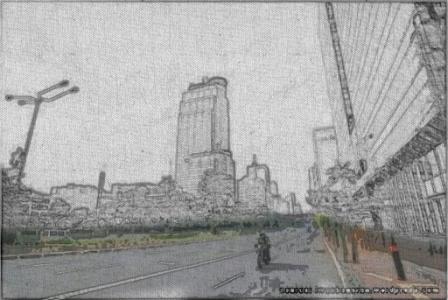
During the period of two days before and after the celebration, Jakarta resembled a deserted city. People who stayed in the city during this period might enjoy driving around downtown easily. The roads were almost free from any public and private transport as those who went to the countryside brought with them their own car or motorcycle.

However, contrary to the deserted roads, the amusement centers like Ancol Coastal and Indonesian Miniature Parks as well as Ragunan Zoo were flooded with citizens who stayed in the city and visitors coming from outside the city. During the last few days, the zoo already registered around 750,000 visitors.


In a certain degree, exodus caused problems for many families who stayed in the city, especially those who had hired the housemaids to do household chores. The housewives had to take over all duties of the housemaids and often went outside with their whole family for having lunch and dinner. And because of this reason, people were crowded in the hyper-marts and malls. 

The exodus also made most of the houses empty and only some big houses were guarded by the security. The district heads always reminded the citizens to report their departure so they could keep eyes on their houses. Some districts even asked the staying residents to help guard the area, especially on the weekend.  

For the city government, it was a good time for them to topple down empty illegal huts and stalls temporarily left by the owner. They were also used to screen the poor newcomers who came together with their residential relatives seeking the opportunity of getting the job. However, the past experience indicates that such governmental prevention has been unsuccessful and ineffective.

We wish you a happy Eid-al-Fitr!

Thursday, July 21, 2011

Can the Road Crossers be Disciplined?

Everybody knows that traffic jams in Jakarta are acute. The standard explanations for that are too many cars and too many motorcycles as compared to the roads available. The situation is worsened by the non-disciplinary drivers, merchandizes put at the side of the road by unconcerned traders, the cars parked at the side of busy roads, and last but not least people cross the road at will.

Based on the reason for the frequencies of accidents of the road crossers and the traffic slow down caused by their crossing, the city government issued the regional law No. 22, 2009 to forbid and fine the person crossing the road at wrong sites. The law was dormant for some reasons for more than 2 years until the police revived it recently.

Under the law, the police are authorized to fine the road crossers Rp 250,000 (US$ 30) for those who don’t want to cross at zebra-cross, traffic light or crossing bridge fly-over the road. As try-out, the police held 2 weeks “Obedient Operation” this current month (July). At this stage, the police would not fine the violators but guide them to cross at the appointed spots.

After this try-out period, the police will impose a fine to the non-obedient road crossers or confiscate their ID cards to be proceeded to court session for recovering their ID after being fined. 

As it is anticipated, many people complain about the regulation for the reason that there are an insufficient number of the crossing bridges and definitely the number of zebra-crosses. For the latter, the government can easily increase the number of zebra-crosses by simply painting the roads in many spots required. In addition, the fine is considered as unreasonably high as most of the road crossers are low-income persons.   

So we urge the city government to paint Jakarta roads as many zebra-crosses as required and let's hope the citizens will obey the rule.  

Monday, July 18, 2011

Jakarta Celebrates Its Anniversary

Jakarta has just celebrated its 484 years of its anniversary marked by the opening of the Jakarta Fair. The city got the honor from the President of the Republic, Susilo Bambang Yudhoyono, who officially opened the Jakarta Fair on June 09 as the mark of the anniversary. Since it was initiated by Governor Ali Sadikin in 1967 the Jakarta Fair grew bigger and promoted more products nationally as well as internationally.
During the fair, lasting from June 9 to July 10, we could see various entertainments, business activities, displays of new products and possibilities of having business trading partners. Visitors amounting to 4,2 million as compared to 3,8 million people last year were entertained by 250 group bands performing life music successively. More than 2,500 national and international companies took part in Jakarta Fair opening 1,300 stands, not to mention outlets and stalls for sidewalk traders.

The total transaction during the event was Rp3.5 trillion (around US$ 4 billion), wherein the last few days the rate of the transaction was higher to triple because of bigger discounts for buyers. The official of the whole activities’ coordinator, the Jakarta International Expo, said that the expo met with their satisfaction.  

The stipulation of the date of June 22, 1527, as the first establishment of Jakarta, causes recent controversies. It was based on one point in time in history almost 5 centuries ago when Fatahillah a commander of Demak Kingdom won the war against Portuguese.

Previously, in 1521, Portuguese held a treaty with Pakuan-Pajajaran, allowing them to construct a fort in the beach of Sunda Kelapa, which is at the north coast of Jakarta today, and annually receive spices from the kingdom as compensation of the Portuguese protection against the enemies. This event was memorized in Padrao Stone which is now kept in National Museum.


The Prince Fatahillah from Demak, Central Java, in coordination with Cirebon, being afraid that the agreement could hamper Islamic development, attacked Sunda Kelapa as well as Portuguese' fort and took it over. But before Fatahillah launched the full war, Portuguese fled away to Malacca where they felt more secure. Meanwhile, the locals, the Betawian people, were driven out without any resistance to the hinterland. The day was coined as Jayakarta, the victory day, taken as the original name of ancient Jakarta.

Some noted Betawian, however, were not happy with the stipulation and prefer instead the date of September 3, 1945, when Soekano stipulated Jakarta as a municipal. Albeit the controversies, as Jakarta has grown for the better, let’s all city residents celebrate the anniversary with joy.


Wednesday, May 18, 2011

Is It Possible Jakarta to Become [Cigarette] Smokeless?

Anywhere you go, either it is a remote place in the frozen climate close to the Arctic,  an arid desert in the middle of Sahara or a humid tropical rain-forest in Indonesia,  and not to mention densely populated cities everywhere in the world, you will find people smoke a cigarette. Jakarta is no exception. 

We have no idea how and when this strange habit first came up to people burning a bunch of dried tobacco leaves and sucking the smoke down into his lungs.  But one is certain, it was Columbus who was responsible for bringing tobacco seeds from America to Europe. From the WHO data, it is clear that tobacco is a major cause of death.  Globally the smoking-related deaths, which more or less reflect Indonesia condition, are 29 percent lung cancer, 24 percent heart disease, 16 percent chronic lung disease, 6 percent stroke, and the remaining are other various diagnoses.  

The tobacco companies in Indonesia produce an estimated 20 billion sticks a year or statistically every person in Indonesia, including children and babies, smoke more than one cigarette every day. The money burnt each year by the smokers is about Rp 20 trillion but that amount of money turns the business of cigarette on which many tobacco farmers, laborers, retailers, the cigarette industries as a whole and part of the government coffer depend on.   

 For the foreigners who visit Jakarta for the first time, they may smell some strong bizarre burning clove odor. That is the “kretek” cigarette, typical tobacco blended with clove, widely consumed by Indonesian people. Jakarta smokers have a bad habit of smoking anytime and anywhere wherever they pleased. They don’t care, no matter whether they are in the street, crowded train or bus, cinema, restaurants, amusement centers or else you name it. Whether you like it or not, you have to join inhaling the cigarette smoke or you have to leave the spot.  

With the aim to reduce the pollution of cigarette smoke, the city government has set an ideal program to free the cigarette smoke in Jakarta by 2012. Jakarta is the first area to initiate cigarette prohibition in its territory. The policy is now followed by many other cities such as Surabaya, Padang, Bogor, Lampung, Bukit Tinggi, and Denpasar. The policy is the strong commitment of the city governments to the health of the citizens. 

Jakarta Gubernatorial regulation No. 88/2010 regulating the smoking prohibition inside the buildings was put into effect since April 1, 2011, after it was socialized during the last six months consecutively since October 2010. The penalty for the smoker violating the regulation is exceedingly severe at Rp 50 million (US$ 5 thousand) but has never been implemented until today. Maybe because the penalty is so high that nobody puts it seriously. Once a  city-police caught a man smoking a cigarette and urged him to pay the fine. The accused took out his wallet and gave the police Rp10,000 (US$ 1) the only money he possessed. The law-enforcer gave him back the money and walked away saying nothing.

Within that time span, there were 92 buildings were considered bad related poor law enforcement related to non-smoking areas. Following the socialization of smoking prohibition issued by the city government, the citizens have got a better perception about it. Even Environment Controlling Body has received 169 complaints about locations which did not supervise yet the non-smoking areas. This indicates that Jakarta citizens have participated in the program. 

Despite protests from cigarette smokers, city government was determined to create clean air from cigarette smoke. Even the efforts are fully supported by the World Health Organization (WHO). Their representative in Jakarta said the Gubernatorial Regulation No.  88/ 2010 is in line with international rules. Tobacco is responsible for the death of 1 in 10 adults.

Monday, May 16, 2011

Indonesian Batik, the Masterpiece of Human Heritage

Indonesia should be proud of its cultural heritage as some of them have been recognized by UNESCO as the masterpiece of human heritage. Among those intangible heritages are traditional puppets (2003), "Kris" ceremonial knives (2005), traditional "batiks" (2009) and "angklung" bamboo musical instrument (2010). Now Indonesia has registered another three of its cultural heritage, namely Balinese traditional dance, Noken  Papuan handicraft and Taman Mini Indonesia Indah (TMII).

The foreigners who come for the first time to visit Jakarta may see the unusual sight of people wearing a colorful shirt. What they are wondering of is batik, a piece of cloth painted with various kinds of the composition of pictures or diagrams. It is a creative art design on a piece of cloth hand-drawn using a liquid candle as the media, to colorize the cloth surface area which is not covered by the liquid candle. The drawings with the liquid candle are done several times until you get the color combination as you wish.  UNESCO has recognized batik as the masterpiece of intangible heritage of humanity on October 2, 2009, following its far and wide fame.

In olden days, batik was worn by people living in Java. The people wore batik as early as the beginning of the 13th century.  Up to the 18th century, batik designs and productions were centered inside the kings’ palaces. At those days, before the liquid candle from oil product was available, people used the bee candle to draw the design. The colors were extracted from various plants and minerals.

At those days, both men and women wore batik as a sarong. The men used to wear batik sarong with a traditional dagger (kris) put at the waist. Batik was produced in such a way that its products were due to certain groups in social classes. There were batiks sarongs designed and produced for high class only. For a kind of batik with certain motifs, only the king and his families were allowed to wear it. Nowadays, we can still see the way of such wearing in the wedding ceremony where the bride and their parents wear such clothes imitating old style high-class wedding ceremony. 

In all, there are around 600 kinds of batik motifs in Indonesia. The cloth can undergo its sales in the form of a piece of clothes, trousers, or a sarong usually worn by women. The picture stands for good fate, high rankings of certain classes in the society or story in the past. Sometimes it resembles abstract paintings which need analysis to reveal its meaning.  The philosophy behind the drawing of a particular batik motif is related to the more subtle social background which needs insight and comprehensive explanation. 

Large scale batik production began only in 1920 when batik centers introduced textile printing machines. Most of its products were then uniforms and their artistic beauty faded away. As such the price became cheaper and common people could easily afford to buy batik products. 

Up to 1960s, batik was used only for sarongs and never for shirts. We are indebted to Ali Sadikin, the then governor of Jakarta, who encouraged the Jakarta citizens to proudly wear batik shirts as national identity. The campaign also accelerated the “swasembada” (national self-supporting) movement through the preference of using national products. 

The areas of batik groceries in Jakarta are mainly in Tanah Abang, from which all batik products are distributed to all over the country. As raw materials for batik are also sold there, some traders from Central Java moved to Jakarta producing their own batik. They brought workers from their home town causing in certain degree urbanization to Jakarta. 

With the aim to collect all kinds of batik designs from all over Indonesia, the Indonesian Batik Foundation (YBI) constructed a batik gallery inside the Indonesian Textile Museum. However, since the show-room allocated for batik is too small, not all batik designs are displayed at one moment. On every three-month period, the content of the gallery is replaced with the new ones. 

We expect that the city government is serious about their plan to construct a new Batik Museum by 2014 and allocate enough budgets for it. The realization of this museum would become a gesture of our appreciation toward batik’s international recognition not only as national heritage but also as the masterpiece of the whole humanity as it has been recognized by  UNESCO in 2009.